Transcript: Is It Ethical to Cooperate with Chinese State Institutions to Secure Incremental Change?
Opening Video
Joanna Chiu (00:00:00):
In practice, cutting ties with Chinese state institutions means cutting ties with Chinese people. This is not a principled position. It is a hawkish fantasy with enormous human consequences.
Isaac Stone Fish (00:00:13):
The Party is so central to China today that when you are engaging with Tsinghua University, you’re engaging with the same entity that runs the camps in Xinjiang. It’s all part of the Communist Party. That’s why it’s unethical to engage with them.
Opening Remarks
John Donvan (00:00:30):
Good afternoon, everyone. Uh, I’m John Donvan. I’m the moderator-in-chief of Open to Debate. And I just wanted to thank you for making this the last stop of your program day because this is gonna be, uh, quite a different event from those that you’ve seen, uh, taking place through the rest of the day in a sense that we actually are staging a debate. The reason we believe in debate is that the reality is that people of good faith, um, can really bring different perspectives to some challenging and complicated and nuanced situations even when they have the same goal. And in figuring out the best way forward and, uh, what should be done, those in disagreement really need to hear each other out. They need to understand why the other side has convictions and opposing convictions. And ultimately, they need to find a way to be persuasive with the argument that they are making. So that’s what you’ll see performed here today. For the duration of the next hour, uh, our guests are opposing debaters.
Also, there’s an experiment that we always run, um, where we are curious to learn how, uh, our debaters’ arguments have resonated with you and ... In terms of persuasiveness. So what we do is we poll our audiences before they’ve heard the arguments and then again after the debate, um, so that we can determine whether minds have been changed or not. So we would like to take our first poll with you now, this c- QR code going up behind me that will lead you to a sample survey. The debate question we’re doing is, “Is it ethical to cooperate with Chinese state institutions to secure incremental change?” So we’re gonna make those arguments and get them started in just a moment, but before we do, I wanna bring to the stage Javier El-Hage, who is the chief legal and policy officer for Human Rights Foundation. Please welcome to the stage.
We can come around front here. I, I just wanted to chat f- f- f- fundamentally to say how pleased we are to have been invited back. Uh, last year was an experiment. Uh, you all took a risk, and I think that it worked. And we’re delighted to be back again, particularly because, uh, we really feel our values, uh, al- are so aligned with yours, particularly when it comes to the issue of free speech. Uh, and that’s where ideas get hashed out. And that’s our commitment. And we know that that’s only a part of your commitment. So thank you so much for having us. Uh, and we’re curious just to understand why you think having debate brought to the program is a good idea.
Javier El-Hage (00:02:56):
Thank you, John. This is hugely important for us. As you know, the main format of the Oslo Freedom Forum are TED Talk-style presentations, the ones that you saw in the morning. And over the years, we’ve been implementing panel conversations. Panel conversations do allow for some opposition of views, but we, we, but, but we think that the, the, the purposeful confrontation of ideas, and, and, and in this case, in a debate format, was perfect to try to achieve what we want, which is to be persuasive. Ultimately, we, we don’t want people to feel that we’re selling them something and that there is no counter argument. And this bring, gives us the perfect format for us. From a free speech perspective, you know, uh, Oliver Wendell Holmes in his Schenck, uh, dissent opinion, he said, “The best test of truth, ultimately, is the power of ideas to impose themselves in the marketplace of ideas.” And this allows us to hear different ideas over the same, the same topic.
Also, it’s a tradition that I think, in Western knowledge, that’s being lost over time, you know? Late scholastics, uh, St. Augustine, St. Thomas, they used to write in a way where they said, on purpose, they said, “This is a proposition. Here is the counter argument. And here’s my take based on that.” And I think this format that you guys created through your amazing organization, Open to Debate, I’m a big fan. I’ve looked it up. You’ve had so many incredible debates over the years. So for us, it’s an honor, really. And we’re so happy that we get to have this, this small space for a, for a, for a purposeful and, uh, and, and, and clear debate on, on difficult topics. Uh, might, people might assume that we have one or the other position on this question, for example, from a policy perspective, but that’s why we wanna test them and we wanna actually, uh, uh, give, uh, attendees the opportunity to make a choice, uh, based on the strength of the arguments of the, of the panelists of [inaudible 00:04:45].
John Donvan (00:04:45):
We, we are honored to be back. Thank you so much.
Javier El-Hage (00:04:46):
Thank you, John. Appreciate it. Thank you. Hope you enjoy it.
The Debate Begins
John Donvan (00:04:51):
Thank you. Let’s invite our debaters to the stage, ladies and gentlemen. Welcome Isaac Stone Fish and Joanna Chiu. So we have two debaters today, to argue this motion, is it ethical to cooperate with Chinese state institutions to secure incremental change? A note on some definitions. When we refer to Chinese state institutions, we are applying a broad brush. So we are including the realms of education and investment and t- joint research and trade and the arts, essentially any aspect of life controlled or influenced by the Chinese Communist Party, which I think both of our debaters agree is pretty much or almost everything. Um, so we’ve met, brought our debaters to the stage, but let’s learn a little bit more about them.
First, I wanna welcome, again, taking the position yes, arguing that cooperation is ethical, I wanna, again, welcome Joanna Chiu. Um, and, Joanna, you are, you’re an expert on China and currently managing partner at Nüora, Global [Advisors], which was founded by journalists and researchers to help organizations navigate Asia’s geopolitics and culture. Uh, in fact, you are a former investigative journalist yourself. You lived in China, you reported on China, you wrote about China, including in your book, China Unbound. Joanna, thanks so much for joining us.
And taking the no position, uh, I wanna welcome Isaac Stone Fish. Isaac, uh, you’ve debated with us before, so I’m gonna say welcome back. You’re the CEO and founder of Strategy Risks, which advises companies on corporate exposure to China and helps them reduce risk. Uh, you’re also the author of a book called America Second. And that’s a book about Beijing’s influence on the United States. Welcome to the program again.
Um, and just very briefly, on a personal note, I know that both of you have lived in China. And I, I just very briefly wanna get a sense of what that experience was like for you. Joanna, first.
Joanna Chiu (00:06:50):
Yeah. Um, so I was born in Hong Kong, but instead of enjoying my life in Canada and turning away, I just really wanted to become a journalist in China and build bridges. So I spent all my career focused on China, first in Hong Kong for newspapers and outlets there, and then in Beijing, and reporting across the country.
John Donvan (00:07:08):
Which so qualifies you for this debate. Thanks so much for joining us. Uh, what about for you, Isaac, your experience living in China?
Isaac Stone Fish (00:07:14):
I lived in Beijing for about six years. Wonderful country. Shame about the Party.
John Donvan (00:07:17):
(laughs) Also qualified to take part in this debate. So let’s get down. We go in three rounds. And in our first round ... I’ll explain the rounds as we go through them. But in our first round, the debaters have the floor, uh, i- individually, uh, with, uh, no interruptions from anybody else. Um, we’re gonna go first with, uh, Joanna, who is arguing that it is ethical to cooperate with Chinese state institutions to secure incremental change. You have four and a half minutes. And the space is yours.
Joanna Chiu (00:07:51):
Imagine a place where state institutions are everywhere. Every university is a state institution. Every NGO must operate under Party supervision. Every private company, including foreign-owned ones, must ultimately answer to Party authority. This is how 1.4 billion people live. If you want to find truly independent organizations, you would have to go off the grid. I would know because I tried. For 15 years, I reported on China as a journalist. I’ve been to underground churches, migrant worker villages, interviewed human rights lawyers, LGBTQ activists, feminist groups. Most of those spaces are now closed.
We are meeting in Oslo today, the city that gives out the Nobel Peace Prize. Liu Xiaobo was the last Chinese citizen to win it. He was inspired by Western philosophy. He went on overseas academic exchanges here in the University of Oslo, at University of Hawaii, and Columbia, Columbia University. The ideas and connections, the very ones my opponent wants to cut off, shaped his manifesto for democratic reform. He was jailed for it. When he was dying of cancer in state custody, I tried to reach him to tell his story. I walked right up to the hospital ward. It was guarded by police. The doors were bolted shut. When he died, Chinese people found ways to mourn him, things like candlelight emojis. And those small gestures made it into the global press. They were not isolated. They were connected.
In practice, cutting ties with Chinese state institutions means cutting ties with Chinese people. This is not a principled position. It is a hawkish fantasy with enormous human consequences. Let’s look at an assumption underlying this debate today, the idea that isolation somehow produces political change in another society. Is there a precedent in modern history? Iran, Cuba, North Korea, decades of isolation and sanctions, and yet none are freer. Let’s look at China’s own recent history. During its most isolated period, the Cultural Revolution unleashed chaos that killed millions of people. Isolation does not protect people. It means there are fewer witnesses. It hardens systems, increases fear and paranoia, and cuts off the channels where human connection and ideas naturally flow.
Isaac and I share a similar path. We both recently left journalism to start China-related consultancies, but we’ve arrived at different conclusions. My work helps organizations navigate Asia as it is, not through a zero-sum lens. Half of our researchers are based in Asia. And while I was living in Beijing, I started and co-founded a global nonprofit, NüVoices, that celebrates women China experts. We now have chapters all around the world. The goal was never to change China from the outside. It was to keep human dialogue and connection alive to support people. When channels close, that’s when propaganda and misinformation can fill the vacuum. When human contact disappears, dehumanization can follow. And dehumanization is what makes war possible. Supporting Isaac’s side doesn’t just fail to produce positive change, it raises the risk of war.
This city gave Liu Xiaobo a Nobel Peace Prize. He couldn’t come to collect it. An empty chair sat in his place. Engagement is not perfect. It should have guardrails. But it does not mean endorsement ‘cause I know a world without connections is not a safer place. It is a more ignorant one, a more dangerous one, full of empty chairs. Choose engagement.
John Donvan (00:12:30):
Thank you, Joanna. Uh, now, Isaac, it is your turn to speak. And once again, to remind people listening, you are arguing it is not ethical to cooperate with Chinese state institutions to secure interme- incremental change. The floor is yours. And, uh, um, Isaac, I’m standing right behind you.
John Donvan (00:12:50):
So yeah. There’s your spot over there.
John Donvan (00:12:53):
You wouldn’t want me lurking over your shoulder through the whole-
John Donvan (00:12:55):
We’ve, we’ve seen that act before.
Isaac Stone Fish (00:12:57):
on the engagement side, so s- ...
Isaac Stone Fish (00:13:02):
There’s a story from 1960 in China, the height of Mao’s Great Famine, of a young Chinese man, a young government official who goes back to his family’s village. And as he’s entering the village, a kind old cadre says, “Son, don’t come in here. There’s no food left. Both your parents have starved to death.” And this young official writes a letter to the central government praising the policies of Mao because how much suffering can one man take? I bring this story up for two reasons. One is one of the many reasons it’s unethical to collaborate, cooperate, engage with Chinese state institutions, is the past of the Chinese Communist Party, but also how important it is for us to empathize with those who have to engage with the Chinese Communist Party, Chinese citizens. It’s not to say that the choices are ethical, but the choices are incredibly difficult and the choices are required. And if I were in that young man’s position, I would have done the same or worse.
The conversation we’re having here is not about the practicality of engagement or the necessity of engagement. It’s about the ethics of engagement. And that makes it a much easier thing to debate very, very clearly on how unethical it is to be engaging with various arms of the Chinese Communist Party and the Chinese Communist Party as a whole. History, the present, and also frankly, most of the time, it just doesn’t work. And so not only by engaging are you acting unethically, you’re acting against your purposes.
So history. The Chinese Communist Party today, to outsiders, like to downplay its links to the past. On every Chinese bill from 1 to 100 is Mao Zedong’s face. He is still the center of the Party. His face still hangs on top of Tiananmen Square. And Mao is one of the great dictators, great butchers of the 20th century. And it’s the same Party channeling the same image. Cultural Revolution, Great Leap Forward, tens of millions of people died in China. And they weren’t from the Cultural Revolution, as my, uh, opponent tried to say. The Cultural Revolution didn’t come because China was isolated. It came because of the Chinese Communist Party. We have to put the blame where the blame belongs.
Uh, the present. Uh, China today economically is much more successful. Um, people don’t starve to death, with the exception of in Shanghai during the lockdowns, uh, when people were shut in their home and, and some ran out of food. But is a country that those in this audience know, um, is still incredibly repressive, incredibly abusive to its own people in ways that take a lot longer than four and a half minutes to go into. Uh, the situation in Xinjiang where upwards of a million Muslims have been placed in concentration camps, in which a recent FT story found, uh, has the highest prison capacity of anywhere in the world. Situation in Tibet, the situation with privacy across China is still quite atrocious.
On the practicality of it, people will often say, “Well, we have to work with China to fight climate change.” Uh, China’s coal consumption has gone up. Uh, China’s carbon emissions actually have gone up about 14% over the last five, six years. And when there was a lot of pushback on that, Beijing decided to measure carbon a different way. And so they said, “Oh, well, it only went up 7%.” There’s dozens of examples, hundreds of examples of entities engaging with the Chinese Communist Party o- only to find their interests thwarted. The Party is brilliant at using its opponents against each other. I think we’re gonna go into that a little bit more detail. But the United Front Work Department, which is the entity in the Communist Party that manages and oversees a lot of the engagement, absolutely brilliant at strengthening the Party’s friends and weakening the Party’s enemies. And those are the entities that we’re pushing back against here.
A final point. Universities, um, nonprofits, as Joanna was saying, uh, the Party is so central to China today that when you are engaging with Tsinghua University, you’re engaging with the same entity that runs the camps in Xinjiang. It’s all part of the Communist Party. That’s why it’s unethical to engage with them. Thank you.
John Donvan (00:17:32):
Thank you. So now we move on to our second round, and it’ll be our longest round in the, in this part of the program. The debaters stay seated. I stay seated. We have more of a free fe- flowing conversation. I’ll be asking questions, uh, of my own based on what I heard in the opening statements. They can also question each other. They can even interrupt each other, if done in good faith. And, uh, later, I’m gonna be bringing in some, uh, questions that were worked out in partnership with the Human Rights Foundation’s China team, which are very, very helpful to this conversation.
But to tell you what I think I heard in the opening statement, uh, on the question of whether it’s ethical to cooperate with Chinese state institutions to secure incremental change, and we’re des- de- defining these institutions very broadly, uh, Joanna Chiu is arguing yes, it is ethical because to do otherwise, uh, essentially, is to abandon the Chinese people to a human rights fate that nobody would want. Um, she points out that, uh, os- isolation and ostracization has not worked in cases like, um, Cuba, uh, and Iran. She says the idea of cutting people off entirely is a hawkish fantasy, uh, it’s dangerous, it’s empty, it raises the risk of war, and it doesn’t really lead to any good.
Uh, I hear you, Isaac, uh, taking the opposite side from two points of view. On the one hand, you’re saying that, uh, while, in some ways, there might be something of a practical case to be made for, uh, for engagement with China, but, which I’ll get to, there’s just an unethical case. You shouldn’t be dealing with, uh, with, uh, entities that, uh, uh, you characterize it, the way that you characterize them, that they just, uh, they don’t, they don’t deserve it, that it’s immoral to even engage with them. But you also argue that it doesn’t work, that, uh, ultimately, um, um, change in China is more likely to come about from ostracization, that that’s the kind of punishment that would, uh, uh, implied punishment that would potentially, uh, cause the Chinese to change, um, Chinese Communist Party to change.
Um, I, wanna, I, I’m interested in this point that you’re making that it’s ... Uh, there’s a separation between practical and ethical. And I wanna ask you, do you, do you buy that distinction? Do you think there’s a difference between what’s ethical and what’s practical? Or are they-
Joanna Chiu (00:19:33):
I agree we shouldn’t spend time debating the practicalities of engagement and where to engage or not, but the ethical is whether it is ethical for incremental change in China. And no human rights organizations or activists in China says that they don’t want the world engaged in China, that they don’t want researchers and international journalists on the ground to tell what is happening. And journalists, include Radio Free Asia, US government-funded journalists were the first to report on the internment camps in Xinjiang. So the world that Isaac is advocating for is one that I have not heard Chinese activists or civil society ask for.
John Donvan (00:20:18):
And, and, and it’s unethical in what sense?
Joanna Chiu (00:20:21):
It’s unethical because it equates the Chinese people with the Chinese state. And we know that China’s not a democracy. Its leaders are not elected. And it is unethical to give up on 1.4 billion Chinese people.
Isaac Stone Fish (00:20:41):
I would say that my esteemed opponent is conflating China and the Chinese Communist Party. And we are defining Chinese state institutions very broadly. But the way to engage with Chinese people is not, as the Party says, people-to-people diplomacy, which is code word for United Front action, but finding ways to engage with individual Chinese outside of a state setting. It’s very challenging, don’t get me wrong, but we’re talking here about what are the ethical imperatives with this. Uh, the second thing-
Joanna Chiu (00:21:12):
Oh, can you give a bit more detail? How would you ... If your goal was to secure change in China, how would you find these individuals outside of state institutions?
Isaac Stone Fish (00:21:21):
I mean, I think we know plenty of those individuals and we know ways of engaging with them outside. And we have these conversations outside of China. You can’t have the change-making conversations inside China. And the organizations that you discuss that are active in China today make horrific ethical compromises to stay there. So there’s a major US, uh, nonprofit institution which, in order to stay in China, shares its global grant-making details with the Ministry of State Security. And they make the same argument that my opponent does. They say, “Well, we have to be in China because we cannot abandon 1.4 billion people.” Well, 1.4 billion people, unfortunately, are better served by human rights associations outside of China than within.
John Donvan (00:22:03):
I, I wanna bring in the, the example of, um, e- of education. So the, the trend in the United States and, uh, also in Europe wh- wh- where for 30 f- to 40 years, there was an increasing number of, uh, students from China coming to study, uh, in the West, uh, has reversed dramatically in the last two years. And I, I’d like to, uh, ask each of you to analyze what that means because on the one hand, I know the US government is, uh, portraying these, uh, students as a security risk, uh, as, m- uh, uh, accusing them of, uh, transfer of technology through knowledge, uh, espionage, et cetera. On the other hand, the argument could be made that those, uh, individuals go back to China with a sense of possibility from having exposure to a society with greater civil liberties. Um, sort of which is it? And again, from the practical and ethical point of view, I’ll take that to you first, Joanna.
Joanna Chiu (00:22:52):
I think when particularly Americans talk about change, like making change around the world, often, it’s implying that they’re most interested in political change, but we’re talking about progress and change in China. And that is in areas that dialogue is actually more possible, places like health, children’s health, maternal health. So the Ministry of Education, China, has been working with UNICEF for decades. And this has greatly improved children’s rural education, disabled children’s access to education. There are many concrete bench- benchmarks of where these areas of cooperation have improved lives for normal people in China. So I hope today that we have a broader view. Our goal is not to create regime change in China. I think that’s a bit of a Western or colonial thinking. Um, we’re talking about what is good for the Chinese people. And that includes things like climate, health, AI, that governments are cooperating, as President Xi and Trump talked about in the last summit, last month in Beijing, that there should be cooperation on guardrails for AI.
John Donvan (00:24:06):
So the, the, the point that, uh, Joanna was just making about the impact on, on children in education, that, that does sound like an ethical good, that good things are happening to the Chinese people as a result of the, the kind of transfer she’s talking about.
Isaac Stone Fish (00:24:18):
So the reason why entities have engaged ... So actually, I’ll respond to this in two ways. One is, is it ethical in 1980s or 1990s to support the Ministry of Health as it acts in China? Different calculus than it is today where China is a wealthy and powerful country. Two is the sacrifices that entities had to make in order to secure that cooperation with the Ministry of Health were pretty extreme. And I think there’s, there’s, broadly speaking, two ethical schools. There’s utilitarian, greatest amount of good for greatest amount of people, but also, “I’m going to behave unethically in order, so I may meet ethical means.” And then there’s the Kantian school, the categorical imperative, act as if your actions become a moral imperative. And certainly, what my colleague is suggesting I don’t think falls in either of those schools, frankly. Uh, second, on the question of regime change being an imperialist fantasy, uh, I believe, and I think Joanna agrees with me, that the Chinese people should be able to decide who their leader is. A- and they cannot do that under the Chinese Communist Party today.
Joanna Chiu (00:25:19):
So, Isaac, uh, could you answer the question that, um, I pose to you? Can you show the chain of causality? The Western world say, all decide to isolate China, including commercial, including the UN groups, UNICEF, uh, including the WHO. How does that lead step by step to any of what we discuss today, uh, improvements in health, civil rights, or even political change where there might be more accountability or transparency?
John Donvan (00:25:50):
And as a prelude to answering that question, I’m curious to know wh- wh- where do you draw the line? Like, how, how f- how much cutting off do you wanna do? Do, you know, if an American jazz orchestra goes to China, or the Berlin Philharmonic, is that okay with you? Or is that something that should not be happening?
Isaac Stone Fish (00:26:05):
So if this were a debate about is it practical to cooperate with Chinese state institutions, my answers would be different. We’re talking about the ethics of working directly with organizations that are complicit with genocide. Uh, to play this out, so if every organization in the world decided to stop working with the Chinese Communist Party, and that included every Chinese organization, um, the Party would either have to crack down greatly or evolve. Um, one of those two things would be required. Um, it’s hard to imagine a scenario where everyone in China just stopped working with the Communist Party, but that kind of collective action, if everyone did that, would have to lead to dramatic change. And maybe the Party would then seize control even deeper, or maybe they would liberalize. It’s impossible to say. However, the ethics of this are not on those who collaborate nearly as much as they are on the co- Chinese Communist Party itself. And that’s the entity that we’re seeking to change.
Joanna Chiu (00:27:05):
And last year, at a open debate forum, you said that Xi Jinping has shown that he’s willing to put a lot of pain on his people. And you just said today that one of the avenues for change is if the world cut off China. And this led to so much s- pain and suffering and frustration from the Chinese people that they basically rise up and there’s a revolution. And are you saying that, um, the West will knowingly cause this and likely a violent clash between the people and the Chinese Communist Party? Is that-
Isaac Stone Fish (00:27:37):
Oh. I mean-
Joanna Chiu (00:27:37):
... the best way to secure change?
Isaac Stone Fish (00:27:39):
... uh, as I said clearly a minute ago, there’s two different options. I mean, we don’t know which one the Party would choose, um, in this imaginary scenario of everyone in the world doing a particular thing. Um, I’d love to hear your thoughts on how you parse out the Ministry of Health that works in Eastern China with the Ministry of Health that’s complicit in Xinjiang.
Joanna Chiu (00:28:00):
So my side does not have to argue that engagement is always successful, or that it always works, or it should work in every single sector. Um, as a Canadian, we actually don’t have these conversations very often on whether Canadians should cut off China because first of all, Beijing would laugh. Like, “We don’t care (laughs) if Canadians stop talking to us.” This is a p- a position that the US, as one of the two superpowers, has a privilege to entertain. And even in the US, there’s no acceptance for this very blanket ban approach. Even at the most hawkish, the US administration is not advocating for cutting off China entirely.
Um, there’s the idea of a small yard and a high fence where when you’re dealing with a state that is hostile or adversary, you close off certain areas that are more vulnerable, that have more national security concerns, like military, satellite technology cooperation, but that keeps it possible to continue engagement in areas like trade of consumer goods in health, in child health, in disease prevention. So I don’t see any example where any government or any legitimate institution is asking for what you’re saying is a reasonable approach.
Isaac Stone Fish (00:29:23):
You keep talking about China as opposed to the Chinese Communist Party. China is not as repressive as North Korea is. There is still daylight between the Party and the people. And there’s still a lot of opportunity for people, you know, for the Chinese in this audience who are a lot more hawkish on the Chinese Communist Party.
The other thing is I, I think you’re downplaying the importance of Canada in the world and also the ability that every individual and every institution has globally to decide if they want to engage with the Chinese Communist Party or not. It’s a really important debate that needs to be happening across institutions, across universities, where they decide, “Okay. Well, there’s a lot of brilliant and wonderful Chinese students. Is it ethical for my university to engage with Tsinghua University or Fudan, um, and work directly with the Communist Party to get these students? Or do I have to make the ethical decision of cutting them off?” And far be it for me to be the architect of the world and tell institutions how to act. What I would strongly encourage is for people to have that debate inside institutions around the world.
Joanna Chiu (00:30:23):
Mm. And I think Canadians can be a bit, you know, self-deprecating, but I think our prime minister has gotten a lot of respect for his speech in Davos where he said that if you’re not at the table, you’re on a menu. And middle powers have a role to play. All democracies have a role to play. And being at the table means you could be part of the framing of these conversations in regulations. If you withdraw completely, you’re not, you don’t have a voice at the table.
John Donvan (00:30:52):
I wanna, uh, shift, uh, the f- the, the geographic framework a little bit away from North America for a moment. Uh, I’ll take this question, uh, to you, Isaac. Um, the Belt and Road Initiative, uh, h- is China’s in- uh, program of investment in the Global South. Um, serious, uh, serious investment in infrastructure, serious investment in agriculture improvement, uh, improvement of food supply, uh, fighting hunger in nations that really need this sort of help. Now, if th- this is, this is engagement with Chinese state institutions on the part of these nations in s- South America and in Africa, do they have a different ethical framework, or, d- d- from the one you’re describing? Or do they have exactly the same ethical decision to make, to engage or not to engage?
Isaac Stone Fish (00:31:35):
So again, I wanna make the very broad point that it’s not for me to tell people in, in Zimbabwe or Bolivia how they make decisions and how they engage. I will say, however, though, oftentimes, this debate, you have people who are very, very critical of global imperialism and colonialism, but then see China doing radically similar things and pretend that it’s okay. Remember interviewing the Rwandan ambassador to Beijing, and said that, “If China colonizes us, we deserve it.” And, and I think that’s very silly. I think there’s this sense that because China is using different terms for what it’s doing, it’s not colonialism, it’s not imperialism. Secondly, it’s very case by case on whether or not added investment from outside entities into countries like Malawi or the Solomon Islands, or you name it, leads actually to better economic outcomes. And then the final one is that Beijing doesn’t invest in isolation. What it brings economically, it brings doubly politically. And there are so many examples of that.
John Donvan (00:32:39):
But if, a- as you’re saying, that you think Canada and the United States should treat China like a pariah, should these nations also be treating China like a pariah? Do they have the same ethical decision to make?
Isaac Stone Fish (00:32:48):
Oh. I’m not saying these countries ... So (laughs), uh, my argument is very easy to straw man. And the idea of treating China like a pariah is very different from working very differently with the Chinese Communist Party.
John Donvan (00:33:00):
Okay. Clarify that.
Isaac Stone Fish (00:33:01):
Um, so the sense is, is it, the question is, ethical to cooperate with Chinese state institutions? The answer is no. Question is, when you’re running a government, do you always have to behave ethically? The answer to that is also no. We make sacrifices as part of our daily life.
Joanna Chiu (00:33:17):
Yeah. And, uh-
Isaac Stone Fish (00:33:17):
This book was made in China. This suit was made in China. We make those sacrifices. It’s not this is an absolute position. It’s what is ethical? And it behooves us to understand that we also behave unethically.
Joanna Chiu (00:33:29):
Mm-hmm. And, Isaac, could you clarify? Do you think foreign journalists should work with the Chinese state to secure visas to report on the ground in China?
Isaac Stone Fish (00:33:37):
I think foreign journalists should understand that they are making an ethical sacrifice in order to do what they feel like is important to do. The-
John Donvan (00:33:45):
You think it’s an ethical sacrifice to go report on China?
Isaac Stone Fish (00:33:47):
I think it’s an excellent ... I think the decision to work with a Chinese state entity ... So I don’t go back to China anymore, which is sad. I miss the place. Um, but the point is not, “Oh, I have to just talk to these visa people.” The point is, and we’ve had these debates, and journalists have these debates all the time, it’s, “I’m not gonna do a certain type of reporting for six months before I go to China because if I don’t do that type of reporting, I’m more likely to get a visa.” It’s a common unspoken secret on how journalists work. They, they wanna get in, and so they pull their punches before they go. Is it for the greater good? Yes. Is that decision ethical? No.
Joanna Chiu (00:34:26):
So you’re saying that it’s for the greater good that we have foreign journalists based in China?
Isaac Stone Fish (00:34:30):
Oh. I think there’s a lot more than that of why foreign journalists should be based in China. And the culprit here is not the journalists themselves. Th- they’re much, much smaller of a piece of this than what the Chinese Communist Party does to require them to do that.
Joanna Chiu (00:34:43):
And I assume you also agree that there should be academic access t- on the ground in China so they can do independent, uh, s- research?
Isaac Stone Fish (00:34:50):
Indep- what is independent research in China today?
Joanna Chiu (00:34:52):
That we’re not getting all the information on China from Chinese state institutions or Chinese state media. That we have, whether it’s through NGOs, civil society, journalists, that we have some multi-layered view into what’s happening in the country.
Isaac Stone Fish (00:35:08):
There’s a, there’s a Mao expression, you know, “Clear water has no fish.” Um, people make sacrifices. I make sacrifices to do certain things, but I think it’s very dangerous for us to assume that the academics who don’t meet with Uyghur students in the months before coming to China are behaving ethically by not meeting with Uyghur students.
Joanna Chiu (00:35:29):
So I think Isaac and I are very in similar circles. As an editor at Foreign Policy Magazine, he actually gave me my first byline. So maybe just to give a bit of context. So foreign journalists, their numbers are dwindling in China. And a lot of that is because most of them have not self-censored. I know because I’ve worked for multiple European, American newsrooms. And there’s these conversations that if we give some, then you keep retreating. So I know the Foreign Correspondents’ Club in China, you know, continues to put up press freedom reports. And I know just recently as a few days ago, the New York Times had its correspondent expelled from China. And there’s only one New York Times journalist left in China. If all of these foreign newsrooms were self-censoring, there’d be more of them (laughs) in China. There’s so few now because a lot of newsrooms continue to cover a wide range of issues on China. And we’re among the only ones to cover human rights issues.
There’s no freedom of the press in China. There’s no independent newsrooms in China. The only information we have from China on human rights is from the outside world and the exchanges and the people on the ground that we have today. So I, I think I’m failing to see, in your world, in your parallel universe, that there is positive change in China, that we have views of what’s happening in the country.
Isaac Stone Fish (00:37:02):
I was just gonna say, I was grateful for the argument you just made because I think it’s an excellent point about on the one hand, journalists are behaving ethically by not doing the sacrifices they need to get into China today. On the other hand, there’s a loss because of that. We have less information than we would otherwise. And one could think too about individuals high up in the Chinese Communist Party who are either secret reformers, or who are leaking information, or who are maybe actively planning to overthrow Xi Jinping. Who knows? The top of the Party is opaque. We don’t understand what’s going on. But those people’s lives are riven from an ethical standpoint. On the one hand, they’re engaging with the Party and they’re acting as part of the Party. On the other hand, they’re trying to bring change within the Party.
Joanna Chiu (00:37:43):
Yeah. There are still whistleblowers, um, in Chinese, within the Chinese government. The NGOs, journalists, they still have sources. It’s harder-
John Donvan (00:37:52):
To, to, to bring it-
Joanna Chiu (00:37:53):
... but it exists.
John Donvan (00:37:53):
... back to the, to the, uh, ethical term- terminology, um, do you agree with this notion that a, a journalist going to China is making an ethical sacrifice?
Joanna Chiu (00:38:01):
No. Often, they’re sacrificing, you know, time with their families. So many correspondents, they’re living in China, but their families are outside. Um, they’re taking great personal risk. Like, I’ve been harassed and assaulted by Chinese police, and it’s just gotten worse. So yeah, we shouldn’t (laughs) be, uh ... I think it’s ... Not to demonize (laughs) journalists who are doing the work on the ground here. Um, I would also like to point out that all international studies point to daylight on what’s happening in China as helpful to the most vulnerable. So a 2021 study analyzing court cases found that when there was more international attention, there was a 70% higher chance of political prisoners being released before sentencing.
So I know that diplomats and journalists always try to get into the courtrooms, and Chinese police always try to get them out. If this attention was irrelevant, why would the Chinese state work so hard to keep the outside world away? And if we do what the CCP wants, which is withdraw and don’t have exchanges and NGO activity and media coverage, that is giving the CCP what it wants. So, Isaac, why do you think this is something that would help?
Isaac Stone Fish (00:39:18):
Oh. It’s not what the CCP wants at all. CCP wants engagements on its terms. It wants the world to engage with the Beijing that it seeks to make us think exists as opposed to the China that actually exists. It doesn’t want people to go live in China, foreigners. It wants foreigners to visit China. You used to love to say, “Kissinger visited China 80 times, so he knows more about China than anyone else.” Well, there are people who actually can go live in China, but Beijing doesn’t like that.
John Donvan (00:39:43):
T- but doesn’t that mean that your, your advocacy of disengagement would give the Chinese Communist Party exactly what it wants?
Isaac Stone Fish (00:39:49):
The Communist Party, a- as I just said, doesn’t want disengagement. It wants engagement on its terms. It, it would love for Joanna and I to go back to China. Would love that. Would love us to go, write self-criticisms, explain the error of our ways, apologize for even implying that China would be better off without the Communist Party run it, apologize for all the lies, the malicious slander we’re spreading about Xinjiang and Tibet, and talk about how wonderful it’d be for the world for China to be the preeminent superpower. That’s what Beijing wants. That’s a lot of engagement.
John Donvan (00:40:19):
I wanna move on to, um ... As I mentioned at the beginning, we’ve partnered this time with the Human Rights Foundation’s China team to, um, de- develop some further questions that, uh, in their view, are gonna challenge our debaters. And so I’m gonna go f- uh, to the first question. This one will be for you, Joanna. Um, the CCP has an extraordinary ability to co-op narratives to improve their own reputation while hiding their own transgressions. The Chinese government, for example, has been accused of greenwashing itself as a global leader on sustainability and green energy and claims to be, uh, putting in an unprecedented amount of investment into sustainable de- development all while displacing Tibetan villages and causing environmental damage. Even if the Chinese government were to promise that they would address issues of human rights abuses in order to do business with democracies, how can we ensure trust that they will be transparent and consistent in these dealings?
Joanna Chiu (00:41:08):
We should not expect assurances. We should not treat the Chinese Communist Party with anything but very, um, serious suspicion. And I think Isaac and I, (laughs) again, very similar paths, after leaving China, we kept writing about China. And we were both, if I can, you know, characterize your book, like, you know, frustrated and upset by Western elites for being so naive about China and to, anti-Communist Party, and to seek, uh, you know, capitalist gain at all costs. And my book and his book seeks to demystify the United Front, how China wields influence. And we mentioned in Belt and Road, a lot of what I try to, you know, help educate people about is that it’s not just through sticks, it’s also through carrots. Like, “Here’s $5 million, a billion dollars to build a road.” But that’s a case for engagement. We wouldn’t have the insights both of us have on the United Front if we didn’t have the, our experience of living in China and opportunities to learn Mandarin.
So we should not trust any assurances from, from any government. It’s about being careful and having knowledge and informed engagement. And we get that from experts. And we have China experts, not from people in DC who’ve never set foot in China, but from keeping those channels for students to have exchanges, to learn Chinese. We need that in order to be smarter when engaging with Beijing in any way.
John Donvan (00:42:46):
You can comment on the response or you can take your question.
Isaac Stone Fish (00:42:49):
I’ll take my question.
John Donvan (00:42:50):
Okay. For Isaac, the clothes on your back, the phone in your pocket, the microphone you’re wearing and using all likely include elements made wholly or in part in the PRC. Is it realistic and pragmatic to entirely steer clear of truly doing business with any and all Chinese state institutions?
Isaac Stone Fish (00:43:07):
Absolutely not. And I was so thrilled that the debate topic, which I keep pointing to, is about ethics as opposed to pragmatism or reality. Um, there’s a lot that we do on a day-to-day basis that requires sacrifices. And this is something we learn when we’re, what, 2 or 3? I mean, this is a very basic idea. W- we don’t live in some sort of ethical paradise that doesn’t require us to make difficult decisions. And, uh, I, I think there’s something to be said about living absolutely and living one’s values. But show of hands in the audience, who has no China-made goods?
John Donvan (00:43:46):
You might, for the record, tell us what you’re seeing.
Isaac Stone Fish (00:43:48):
Ah, yes. For people who are watching at home, not a single hand was raised.
John Donvan (00:43:54):
Would you care to comment?
Joanna Chiu (00:43:54):
So, uh, I see Isaac as arguing for my side. (laughs)
Isaac Stone Fish (00:43:57):
It’s good. I see you for arguing for my side. (laughs)
Joanna Chiu (00:43:59):
Oh, okay.
John Donvan (00:43:59):
How so?
Joanna Chiu (00:44:01):
Because he’s saying that, you know, people make compromises sometimes. And there’s basically no ability to cut off from Chinese state institutions, and there shouldn’t be.
Isaac Stone Fish (00:44:17):
So the question of should one take the ethical stance ... So my company, we d- we don’t engage, uh, with the Chinese Communist Party. We engage with Chinese people. We engage with entities that engage with the Chinese Communist Party. Um, but we made the decision early on that it is not safe, practical, or ethical to be working with the Chinese Communist Party. Um, so there’s certainly a lot more that most entities could do that would be, I think, both beneficial for, you know, China as a whole and Chinese people, and would probably be beneficial for them. Um, but again, I’m trying not to preach or, or harp on certainly these points. And I, and I don’t want to be the ethical arbiter for entities around the world. That said, i- is it ethical? It, it’s not.
John Donvan (00:45:03):
Who, who, who are you ... And I’m not saying this facetiously. When you say you don’t wanna be the ethical arbiter for entities around the world, who, whose position are you representing when you speak about the ethical position?
Isaac Stone Fish (00:45:13):
Oh. I’m representing my own position. Um-
John Donvan (00:45:15):
Just yourself?
Isaac Stone Fish (00:45:16):
Well, I, I think the, uh, US entities, US institutions, US universities, um, those entities specifically, and, you know, US-China watchers. Um, happy to ... I, I think it’s ... As we’re talking about the world, I’m happy to say, “Oh, here, here’s what I think Botswana should do,” but I wanna be careful about stepping into shoes that I don’t fully understand.
Joanna Chiu (00:45:38):
And your company helps, uh, foreign companies, uh, engage with Chinese businesses. Do you ever advise them to shut down their China-based businesses entirely?
Isaac Stone Fish (00:45:50):
So we help companies understand and reduce their China risk. And the, in certain cases, we feel like the risks are worth it. And so, you know, and we-
John Donvan (00:46:00):
That’s a practical, not an ethical case you’re making to those companies?
Isaac Stone Fish (00:46:03):
The, we would love to be making ethical cases to companies. I think as you’ll, as you’ll find, they very rarely wanna hear those arguments. They wanna hear about public affairs, they wanna hear about the financial, uh, impact of what they’re doing. They, they don’t wanna hear, “This is what Immanuel Kant said, and this is what John Stuart Mill said, and here’s a way to try to parse those things.”
John Donvan (00:46:22):
Joanna, question for you. Looking at the current state of business, US firms have not been successful at compelling Chinese businesses to adhere to universal principles, such as human rights or the rule of law, in exchange for participation in the global economy. On the other hand, Chinese firms have been quite successful at engaging US firms in cutting deals that prop up and abet Chinese transgressions, whether that be multinational companies such as the Hilton Hotels from exten- s- expanding into the Uyghur region next to reeducation camps, or buying cotton and goods from f- made from forced labor. If US firms were to attempt to engage China in limited and strategic ways while addressing human rights, for instance, which you argue is possible, what are the incentives powerful enough or accountability mechanisms strong enough to allow for ethical cooperations between democratic states and China? And if they exist, why haven’t we used them yet?
Joanna Chiu (00:47:13):
Yeah. So my main argument or argument at all is not that private companies in the West are the ones that are most likely to create incremental change in China. Um, I’m mostly looking at track II diplomacy. Journalists, researchers, NGO workers, um, UN, UNICEF, World Bank, these are the ones with track records of producing actual concrete changes in China society. And businesses, like Isaac said, will also, will always be looking at their bottom line and their shareholders. So no, I don’t think businesses are the best way to create change, but when governments put regulations in place, like the Uyghur Forced Labor Protection Act, um, which came as a result of investigators and NGOs and journalists on the ground t- that gave information on how Uyghur forced labor are part of supply chains, part of cotton making, part of my firm’s work is actually helping these companies do their due diligence to figure out if any part of their supply chain is compromised.
And companies do care about that because there are s- actual consequences in, you know, global regulations that if they, their supply chains are found to have forced labor in them, that there are real fines and consequences. So I think we shouldn’t think of companies as, you know, Trojan horses. Um, we should support track II diplomacy. Um, but also, there are real, when there are real consequences to doing business with certain aspects of, uh, forced labor, uh, child labor in China, I do see actual, um, you know, investment in trying to avoid that.
John Donvan (00:48:54):
So, uh, uh, d- on the, on the Uyghur Forced Labor Act, it, uh, that doesn’t seem like an example of engagement. That, if anything, seems like an example of, uh ... I- it’s, it’s an isolating move.
Joanna Chiu (00:49:02):
No. I would s- ... The Uyghur Forced Labor Act is not telling companies not to trade with China. It’s telling companies to do so with accountability and transparency, and to show their supply chain. So I think this is a very positive example of engagement that’s informed by deep research on the ground that only international researchers and journalists were able to provide.
Isaac Stone Fish (00:49:24):
I would say the UFLPA, uh, Uyghur Forced Labor pre- Prevention Act, is, is definitely a tool for decoupling. And the US Congress didn’t say it that way all that explicitly, but the idea is it creates a rebuttable presumption that requires anyone importing from Xinjiang to prove that there’s no forced labor in the supply chain, which is almost impossible because of the opacity in Xinjiang. And so it raises the cost for US companies to engage with China. And I think for that reason, it was quite an ethical act and something rare to see from a government body on that.
Joanna Chiu (00:49:55):
Mm-hmm. I just had a conversation with, uh, a human rights worker, um, who comes from Taiwanese ancestry, just before the talk today. And she said that for their latest report on forced labor, they actually got responses from some Chinese companies on their supply chains. And she doesn’t know exactly why, but she credits things like actual regulations that makes companies based in China feel more like that they have to provide answers to a Chinese human rights NGO that’s based in New York.
John Donvan (00:50:29):
The last question is for you, Isaac. And this, I think we touched on this a little bit, but we can, uh, go over it in more depth. The Belt and Road Initiative is increasing connectivity and building infrastructural projects that are providing communities with educational and economic opportunities in healthcare. What do you say to those people who are directly benefiting from the BRI, who simply wanna put food on the table? Why should they care about the complicity and rights abuses of Chinese state institutions when they are simply trying to survive day by day?
Isaac Stone Fish (00:50:58):
Yeah. I, I don’t know about this sort of imagined, uh, subaltern who is, is just trying to survive day by day, and then, um, you know, re- receives a fish or, uh, a healthcare subsidy from a Chinese entity and then goes on TV and, and praises the Chinese Communist Party. I, I think a lot of that comes from the Party’s own media on this engagement. Um, the second thing is ... And again, I’m, I’m trying to be careful not to-
John Donvan (00:51:21):
Right.
Isaac Stone Fish (00:51:22):
... get in the shoes of, of someone who goes and has to decide between a Huawei cellphone or no cellphone, you know? And in, in that case, that’s a very difficult decision to make. But, you know, again, as human beings, we often behave unethically in order to do what we feel like is best for ourselves and our family.
John Donvan (00:51:39):
How do you se- ... In your, in all of your arguments, how do you separate, uh, the ethical framework from the i- impact of the behavior? I mean ...
Isaac Stone Fish (00:51:48):
I don’t think that this sort of, you know, nameless Zimbabwean farmer buying a, a Huawei cellphone actually brings incremental positive change to China. I think it makes Huawei slightly wealthier. I think it makes the Chinese Communist Party slightly more entrenched globally. And I don’t think his actions are beneficial. Again, I don’t think I have the right to judge him for that decision, but I don’t think that’s what’s gonna bring change to China.
John Donvan (00:52:11):
You care to comment on the question?
Joanna Chiu (00:52:12):
Uh, no.
John Donvan (00:52:13):
Okay. So now we’re gonna move on to, uh, what we call a lightning round. Um, we have five questions that we’re looking for, um, very short answers, almost yes or no plus a little bit more. Um, question number one. And I will, um, I should have brought out a coin to toss, but I won’t. (laughs) I’ll just, I’ll go to you, Joanna. Question number one, would a change of leadership in China change your answer to the question we’re debating?
Joanna Chiu (00:52:36):
No. Engagement creates channels and visibility regardless of who’s in charge.
Isaac Stone Fish (00:52:41):
If the Communist Party falls, coin flip on if it’s better or worse.
John Donvan (00:52:45):
Okay. Question number two, if China moves militarily on Taiwan, should all cooperation end immediately? Joanna?
Joanna Chiu (00:52:52):
Some, but not all. In a conflict, that’s why you need channels with diplomacy and information more.
John Donvan (00:52:58):
Uh, uh, so I would like to dig in a little bit. When you say some and not all, what, how do you categorize the, the division?
Joanna Chiu (00:53:04):
And during a conflict, you may want to cut some economic, especially military, cooperation. If there’s any, like, military research going on, probably cut that. But there, you know, having people on the ground, having communication channels and diplomats being able to do the work, that’s what you need more during a conflict.
John Donvan (00:53:24):
Okay. Isaac, I think this question’s really easy for you, this one. (laughs) If China moves militarily on Taiwan, should we c- cut all, uh, cooperation immediately?
Isaac Stone Fish (00:53:32):
Uh, partial invasion, no. Full-scale invasion, basically all.
John Donvan (00:53:36):
Um, let’s talk about what happened with TikTok. Um, the US government claiming that, um, the company ByteDance constituted a security threat through its, uh, social media app, TikTok, uh, was forced by the US to sell its operations to US owners, uh, and come under their control. In light of the sides that you’re each arguing, does this, to you, constitute a reasonable move? Joanna?
Joanna Chiu (00:53:57):
Yes, because it was a result of open dialogue between US officials and ByteDance, and there was a court process.
John Donvan (00:54:04):
Do you feel it represents a kind of engagement?
Joanna Chiu (00:54:06):
It represents engagement. Um, I wouldn’t say it was done right the whole time, but the final result was something that ByteDance agreed to.
Isaac Stone Fish (00:54:16):
So ByteDance is a problem for, for two reasons. One is still extant links with the Chinese Communist Party. Two is the brain rot of tens of millions of Americans being addicted, uh, for another reason to their phone. So no, I, I don’t think it’s ethical.
John Donvan (00:54:33):
Our fourth question. Um, Joanna, can you name one instance of where cooperation with a Chinese institution, in retrospect, was clearly a mistake?
Joanna Chiu (00:54:43):
Yes. When universities around the world accepted Confucius Institutes on campuses without guardrails or oversight.
John Donvan (00:54:50):
Why?
Joanna Chiu (00:54:51):
Because a lot of the Chinese language material, uh, pushed pro-CCP agendas and, um, there was c- censorship pressures in, within global campuses. So yeah, that’s a example of engagement that’s not clear, uh, if that doesn’t have guardrails. And I’ve been calling for informed engagement with information and guardrails.
John Donvan (00:55:14):
During the course of this debate-
Joanna Chiu (00:55:15):
Yeah.
John Donvan (00:55:15):
... you mean, yes?
Isaac Stone Fish (00:55:16):
Uh, same answer, except they, they did have guardrails, and it still didn’t work. (laughs)
John Donvan (00:55:21):
Finally, our question asks about incremental change. Is any incremental change happening? Can you name a concrete example from the last five years?
Joanna Chiu (00:55:29):
I think the most powerful example of how important it is is Xinjiang because it was only international researchers and journalists who got the information out. And Beijing went from denying the camps existed to partly, partially dismantling them.
Isaac Stone Fish (00:55:45):
China’s so large and complex. It’s hundreds of thousands of steps backwards, slightly fewer than hundreds of thousands of steps forwards. So there, there are so many incremental changes happening all the time, but I do not think it’s going in the right direction.
John Donvan (00:55:57):
Okay. Thank you for finishing the lightning round. And we’re coming down to the home stretch of this debate. And that’s where, uh, each of the debaters, uh, will be making a closing statement one more time to try to persuade you to their side of the argument. And again, we’re gonna poll you, uh, afterwards with the QR code that’ll be put up on the screen. Um, and so, uh, we’re g- gonna go in the same speaking order for our closing round. Uh, Joanna, you have two minutes. And the floor is yours.
Joanna Chiu (00:56:24):
Okay. We have been discussing whether engagement with China can produce incremental progress or whether isolation can somehow produce political change. A vote for my side is a vote for keeping channels open in business, climate, health, education, and the kinds of exchange that have no strategic purpose at all, friendships, relationships, ordinary human connection. A vote for Isaac’s side is a vote for a worldview that essentially equates the Chinese people with the Chinese state and ultimately gives up on them. We don’t have to imagine where that leads. We saw this when the US and China were in a race to the bottom, cutting visa exchanges, cutting, closing down consulates. And the people who paid the price are not senior officials in Washington or Beijing. They were ordinary people, researchers, journalists, and families cut off from each other.
This is where so-called principled dissent leads, fewer channels for understanding, more suspicion, more nationalism, and greater risk of war. There is no perfect solution here. The reshin- the resolution asks whether engagement can create incremental progress, not whether it always succeeds. And I cannot imagine a safer world built around 1.4 billion people living in isolation from the rest of humanity.
I am one of hundreds of millions of people of Chinese ancestry who holds liberal values, not because a government handed them to us, but because people are more complex than political systems. A vote for me stands for the belief that people can change when they remain in contact with each other. The idea that isolation produces progress, history suggests otherwise. If you’re confident in the value of open societies, you should believe those values are stronger through contact and exchange, not fear. The alternative to engagement is not freedom. It is ignorance. Vote for the side that still believes in human possibility.
John Donvan (00:58:29):
And, Isaac, uh, you get the last word.
Isaac Stone Fish (00:58:36):
So a Chinese artist that I knew, who collaborated with the state, who when Ai Weiwei was imprisoned, would draw on her hand a watch. And each day, she would erase it and draw it anew, symbolizing the number of days that he was in prison. And this was a very, very small ethical act of resistance amid a career that she had to spend navigating a deeply unethical entity. I think we’re having a different debate. The debate is not is it practical to engage with the Chinese Communist Party? Is it necessary to engage with the Chinese Communist Party? The debate is, is it ethical to do so? And that’s what we have to focus on. That’s what you have to remember as you go home and think about this and you think about your own behavior vis-a-vis Chinese universities.
The point is not to isolate Chinese people. The point is not to demonize Chinese people. The point is to realize the amount of control the Chinese Communist Party has over China today and figure out other ways, thoughtful ways, subversive ways of engaging with Chinese people outside of China. Again, people-to-people diplomacy sounds like such a good thing till you realize that people-to-people is a United Front term. Working with Chinese universities to bring Chinese students here has a lot of benefits. And you have to understand that Beijing uses Chinese students as pawns, not willingly, unwillingly. We have to understand the way that the system operates in China today to understand the sacrifices that we make to engage.
And the great paradox about this conversation is, you know, both Joanna and I, in order to have the insights we had about China, have made, and it, don’t, if you don’t mind if I speak for you here, but made ethical sacrifices to be there. Uh, my first entity, my first entry into China was a scholarship that I got via the Chinese Communist Party, my first studying there. So I’ve made those sacrifices. Far be it for me to tell people not to make the same ethical sacrifices that I made, but it’s so crucially important to understand that’s not ethical behavior. Thank you.
John Donvan (01:00:42):
So in a, in a moment, I’ll ask you to, to take the poll again. I just wanna request that if you didn’t take the poll the first time, please don’t take it the second time. Um, and, uh, before we do that, I, I just wanna say a couple of things. One thing, I, I w- I wanna thank, once again, uh, the Human Rights Foundation for having us here. Um, I also wanna thank, uh, our, our CEO, Lia Matthow, our executive producer, Alexis Pancrazi. And also, a board member of our organization helped forge this partnership last year, and that’s Clea Conner, who’s in the audience somewhere. So to all of you, I just wanna thank you and give you a round of applause for what you’ve done.
Um, but mostly, I wanna thank our debaters. We try to make the point that what can, you just saw is something that can happen, that people can disagree in, in principle with deep convictions, but do so in a way that’s respectful, uh, and that sheds light and that makes all of us think, makes all of us understand what the trade-offs are. Uh, and the two of you did this so excellently. I just wanna thank you so much for that. Um, that, that deserves one more round of applause.
Uh, as you go to vote on the QR code, I’m just curious. We’re gonna publish the results tomorrow morning. It’ll show up on the app. And I’m just curious, uh, as a ... Again, by round of applause, um, I’m, I’m gonna ask did any- anybody change their mind from any position to any other position, from yes to no, no to yes, undecided to yes, undecided to no? Just by a round of applause, did anybody move during the course of the debate?
Wow. All right. I mean, to that, to us, that proves that people were really listening and, and meeting our, our goal of being open to debate. So thank you very much for that. Please vote. And I wanna ask our debaters to step forward and shake hands as we wrap up. Thank you, everybody. Have a good evening.
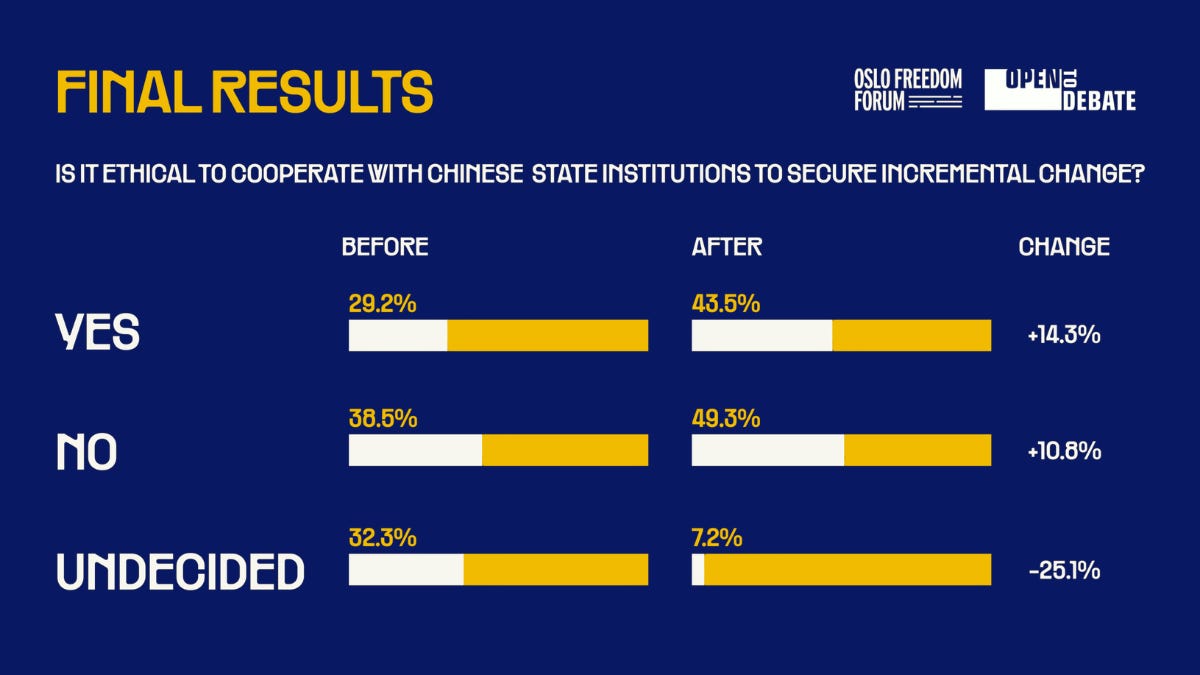
Before the debate, 29.2% voted yes on the question that it is ethical to cooperate with China on these issues, 38.5% voted no, 32.3% were undecided.
After the debate ended, the no side got 49.3%, 43.5% of the audience voted yes. To boil that all down for you, the yes side, argued by Joanna Chiu, saw the biggest change in the vote to her side at 14.3% going over, and thus was the most persuasive in this debate.