

This Week: Legally Assisted Suicide?
A debate over dignity, choice, and safeguards

We choose how we live our lives, but how much agency should we have in determining how and when we die?
This week’s debate is, yes, about policy and quite timely, given New York Governor Kathy Hochul’s agreement with the state legislature to pass the Medical Aid in Dying Act, legislation that would permit terminally ill and mentally competent adults with less than six months to access life-ending medication. But this debate is also very personal and poignant, as several of the debaters with lived experience on this topic share deeply moving experiences.
This debate is from our archives, but it remains an essential listen as modern society continues to grapple with ethical, medical, and legal issues surrounding an issue that was once considered fringe, but is now a practice adopted in some form in a growing number of states, in Canada, and across Europe.
Let us know what you think.
ARGUING YES:
Peter Singer: Co-Founder of the Effective Altruism movement; Professor Emeritus of Bioethics at Princeton University
“…There is a lot of unnecessary suffering. Whether it's excruciating pain or not, there is suffering and distress of various sorts, which continues and is going to continue for the foreseeable future in this system, and it could be relieved by a relatively simple legislative reform that exists already and has been shown to work.”
Andrew Solomon: Author of “Far From the Tree”; Professor of Clinical Psychology at Columbia University Medical Center and Weill Cornell Medical College
“It’s nothing short of medical arrogance to say that palliative care and hospice can adequately deal with the end of every life.”
ARGUING NO:
Ilora Finlay, The Baroness Finlay of Llandaff: Former President of the British Medical Association; Member of the House of Lords
“When you normalize physician-assisted suicide, the underlying social dynamic changes; laws aren't just regulatory instruments. They send a message. The message they send is that if you are terminally ill, ending your life is something that you probably ought to think about.”
Daniel Sulmasy: André Hellgers Professor of Biomedical Ethics in the Departments of Medicine and Philosophy and Director of the Kennedy Institute of Ethics at Georgetown University
“You see, assisted suicide flips the default switch. The question, the terminally ill here, even if never spoken, is ‘You've become a burden for you and for us. Why haven't you gotten rid of yourself yet?’”
Open to Debate, As Seen on Socials
This week, a clip from our conversation with Carissa Véliz and Kenneth Cukier sparked an outpouring of discussion on LinkedIn and Instagram. From bureaucracies to big data, the clip challenges a deeply held assumption: that numbers are neutral. Instead, it asks us to reckon with how math, statistics, and data are shaped by human choices—and how those choices can amplify some voices while silencing others.
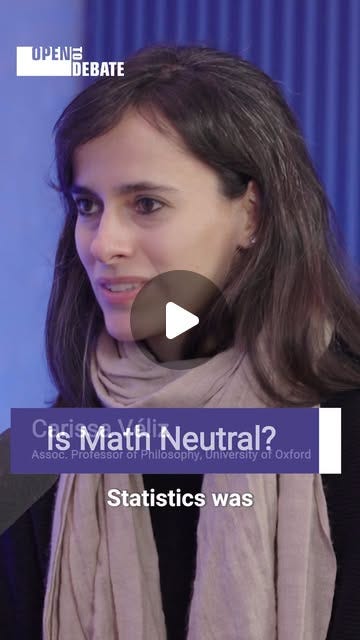
Watch it now on Instagram and LinkedIn and weigh in: Can numbers ever be neutral, or are they always political?
NOTES
Since this debate first aired, here’s what our debaters have been up to:
Peter Singer, who has started a podcast called Lives Well Lived and has not changed his position, says:
“We have another 12 years of experience with voluntary assisted dying, and none of the countries or states that legalized it previously have repealed it. In addition, many more countries and states have now legalized it since the debate in 2014:
Canada, Colombia, New Zealand, Spain, Austria, and Portugal have legalized either physician-assisted suicide or euthanasia on a national level.
In the United States, these states have legalized assisted suicide:
California (2016)
Colorado (2016)
District of Columbia (2017)
Hawaii (2019)
New Jersey (2019)
Maine (2019)
New Mexico (2021)
Illinois (2025)
Uruguay’s Senate recently passed a law in October 2024, but it is not yet in effect.”
Ilora Finlay, The Baroness Finlay of Llandaff, participated in a recent debate on January 23 in the U.K.’s Parliament, where she explained the difference between assisted suicide and treatment cessation.
From Andrew Solomon, who is writing a book on youth suicide:
“I have since seen the law on this subject open and expand in country after country. At a time when the United States is restricting freedoms we once took for granted, it is the determination of activists who have witnessed endless unnecessary suffering who have fought in some states for the freedoms I endorsed in this debate.
There are many people who make decisions that are not informed or are not true, but the right to die is as fundamental as the decision to live. For those whose suffering cannot be alleviated and who cannot find ways to tolerate their own pain and are unlikely to do so, the choice to die should be a guaranteed civil right, to be met not with fearfulness and resistance from a larger population that is threatened by other people’s decisions, but with openness…
No doctor should be obliged to help a patient to die, but every patient whose wish to die has passed the basic safeguards against error and folly should be able to find a doctor to make such death as painless and straightforward as possible. No one whose suffering is genuinely irresolvable should be imprisoned in it. Such immuring of people in their own anguish may not be unusual, but it is, without question, terribly cruel.”
Daniel Sulmasy provided updated resources from two articles of The Atlantic, the BMJ Supportive & Palliative Care journal, the Minerva Anestesiol, and the Journal of General Internal Medicine.
In the News
War at Home, 'Peace' Abroad, Truth in Neither
Garry Kasparov | January 27, 2026
Watch Garry debate that NATO should admit Ukraine
Behind the Curtain: Anthropic's warning to the world
Jim VandeHei and Mike Allen | January 30, 2026
Watch Jim debate that it’s time to say good riddance to mainstream media
Cronyism, Not Competition, Is Driving U.S. Fuel Markets
Stephen Moore | January 29, 2026
Watch Stephen debate that Trump was right to increase tariffs on Chinese imports
I’m a Sex and Relationships Expert but Couldn’t Find Love. Then I Took My Own Advice
Dr. Justin Garcia | January 28, 2026
Watch Justin debate that dating an AI is not better than dating a human
Inspiration and Curiosity from the Team
From Lia, our CEO:
“I’m a little late to reading the popular 2025 release, 1929, the sheer physical size of which forced me to check luggage when I picked it up on a business trip.
But Andrew Ross Sorkin’s 1929 is a fascinating historical feat, examining not only economic trends but the very human dimensions of greed, fear, and other psychological predispositions that fuel systemic failure. As others have noted, it’s remarkably hard to put down and reads less like history than a thriller.”
From Catie, Our Editorial Producer:
“I’ve been going to see a lot of movies this Oscar season, and the best one I’ve seen so far is No Other Choice. This Korean thriller/comedy follows a man who doesn’t know what to do with his life after losing his job. It tackles how much importance we put on work (which, funnily enough, ties in nicely with our upcoming debate on AI and work) and is a very tense and darkly funny watch.”
As a patient with a degenerative disease I find that there is be never a discussion about the paid care that I need but rather about preserving my life without one, which I don’t need. I feel the ones against don’t want people to get away with death, somewhat like the life police, “nobody can die under my watch”
I am a PT working with hospitalized ill and injured patients. My observations: 1) for the very elderly, families (usually adult children) make decisions about treatment or lack thereof. 2) The patient frequently endorses whatever the family has decided. 3) Families and patients frequently choose treatment rather than hospice, unless patients are very close to death (days or weeks, not months). It will be interesting to see how Medical Aid in Dying plays out in my state of Illinois, but I dont expect a big rush of people to choose MAID.